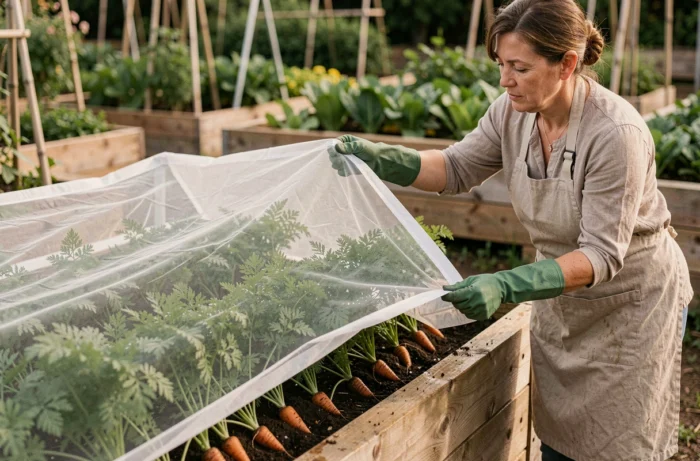
The carrot fly (Psila rosae) lays its eggs at the base of the plants, and its larvae burrow brown galleries into the roots. The insect netting is the most reliable physical barrier to prevent this laying. The difficulty lies in determining when this net can be removed without exposing the crop to a new wave of infestation.
Carrot fly flights: two generations to monitor
The carrot fly does not manifest continuously. It experiences at least two distinct flight peaks during the year, sometimes three depending on the regional climate. The first generation of adults appears in spring, the second at the end of summer.
The problem for the gardener is that the flight dates vary from one region and year to another. A mild spring accelerates the cycle, while a cool summer delays it. No fixed date on the calendar guarantees that the flies have completed their activity.
Understanding the carrot fly in the vegetable garden and its laying periods allows for adjusting protection rather than relying on a generic guideline.
Yellow sticky traps placed near the rows of carrots help to detect the presence of adults. As long as flies are being captured, the net must remain in place. The absence of captures for several consecutive weeks indicates a lull, but not necessarily the definitive end of the risk.
Removing the insect net from carrots: harvest as a reference
The safest recommendation is straightforward: the net should be removed at harvest time, not before. As long as the carrots remain in the ground, they are a target for females seeking laying sites. Removing the protection between two generations amounts to betting on an approximate schedule.
This principle is particularly valid for storage varieties, which remain in the ground until autumn. They go through the active period of the second generation of flies, which often causes the most visible damage to mature roots.
Early harvest and risk reduction
A complementary strategy involves advancing the harvest date. Staggered sowings, harvested before the late generations appear, limit the exposure duration of the roots. This approach has shown its value under certain climatic conditions, but it requires giving up long-cycle varieties.
In summary, two logics coexist:
- Keep the net in place from sowing until harvest, regardless of the date, for maximum protection
- Shorten the growing period by choosing early varieties, which mechanically reduces the time the net is needed
- Combine both by staggering sowings to harvest in successive batches, with each batch being uncovered only at the time of pulling
Common mistakes when removing the net in the vegetable garden
Removing the net “because it’s July” is the most common mistake. The first generation may have finished laying, but the second is preparing. A net removed between two generations exposes the carrots to the next peak.
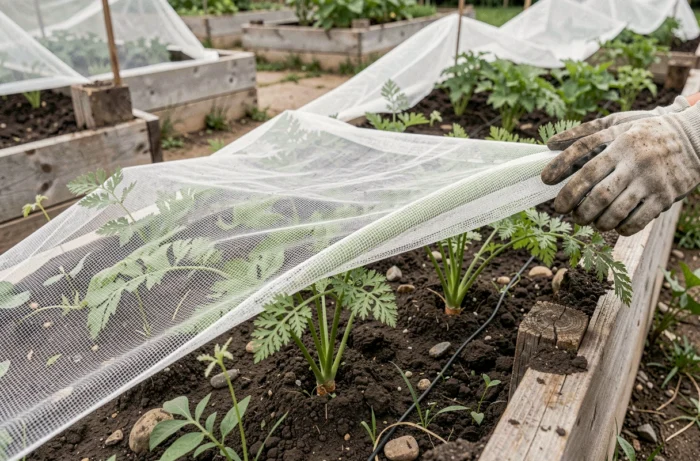
The other trap concerns sealing. A net poorly secured to the ground, with raised edges or holes, allows flies to enter even if it remains in place. Before each re-cultivation, checking the condition of the net and the airtight closure of the edges at ground level is a precaution that determines the overall effectiveness of the protection.
Opening the net for weeding or thinning
Weeding and thinning sometimes require lifting the net. These interventions should be as brief as possible and carried out outside of active flight periods. Acting early in the morning, when flies are less active, reduces the risk of laying during the opening.
Sealing the edges immediately after the intervention limits the exposure window. A net left slightly open for half a day is enough for a female to come and lay her eggs at the collar of the plants.

Insect net for carrots: choosing the right mesh and installation
The carrot fly measures about four to five millimeters. A fine mesh net, tight enough to block an insect of this size, is necessary. Too loose veils or nets designed for larger pests allow Psila rosae to pass through without difficulty.
The material (polyethylene, polypropylene) must allow the circulation of air, light, and rainwater. A net that suffocates the crop or prevents watering creates other problems (fungal diseases, water stress).
Points to check before and during the season:
- The mesh is fine enough to block insects a few millimeters in size
- The edges are buried or weighted along the entire length of the row, with no gaps at ground level
- The net is installed as soon as sowing begins, before the first spring flight, and not after the seedlings have emerged
- No tears are visible (inspect after each episode of wind or hail)
A net in good condition, installed early and removed only at harvest, provides the most effective protection against the carrot fly without resorting to chemical treatment. The removal schedule does not need to be complicated: it coincides with the day the carrots come out of the ground.