A large garden stone often weighs several dozen kilograms, sometimes several hundred. Buying it from a quarry or a garden center represents a significant budget, especially with delivery. However, it is possible to collect stones for free, provided you know where to look and respect some often-ignored property rules.
Free stones and property: what the law requires before collecting
Before loading the trunk, a legal clarification is necessary. A stone placed on a property belongs to the owner of that property, even if it appears abandoned. On a construction site, materials belong to the project owner or the contracting company. The FNTP identifies the ownership of materials and their traceability among the key points of reuse in construction.
Collecting in natural environments poses another problem. On the coast or in a protected area, collecting stones may be prohibited and subject to fines. The rules vary depending on the site manager and the municipality involved.
In practice, the process is simple: request written permission from the landowner, the town hall, or the site manager. This reflex avoids any disputes and often opens the door to voluntary donations, as many property owners are looking to get rid of cumbersome blocks.
To know precisely where to find large free stones, you need to combine several local sources rather than limit yourself to a single channel.
Farmers and land being cleared: the most underutilized source
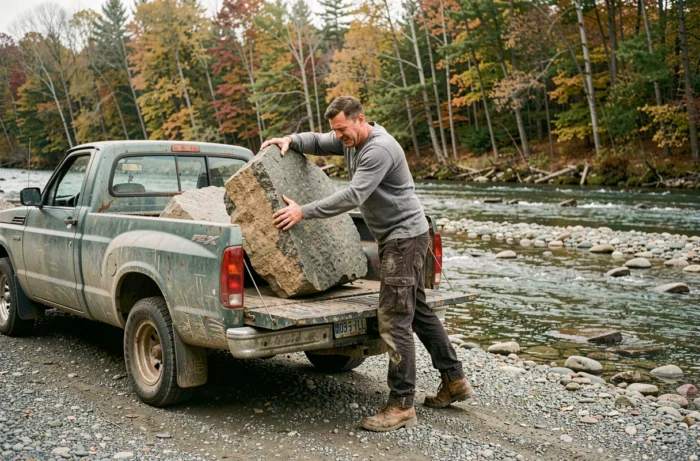
Competitors mention quarries, classified ads, and garden centers. However, the most reliable source for large free stones remains the agricultural sector.
Farmers extract stones from their fields every year. Stone picking is a recurring chore, especially on limestone or granite soils. These blocks accumulate at the edges of plots, sometimes in large piles, with no commercial value for the farmer.
Contact farms directly around you. A visit to the town hall often helps to obtain names. Local agricultural cooperatives sometimes post ads on their boards or in their internal newsletters.
Land being cleared or excavated also produces significant volumes of extracted stones. Excavation companies pay to dispose of these materials at sorting centers. Offering to collect blocks on-site, with the project owner’s agreement, saves them a truck trip.
PEMD diagnosis and demolition sites: spotting stones before their removal
A lead missing from most guides concerns the PEMD diagnosis (products, equipment, materials, and waste). For certain renovation or demolition operations, this preliminary diagnosis lists the materials present and assesses their potential for reuse.
Specifically, cut stones, rubble, foundation blocks, and wall elements are included in the inventory. Contacting the project owner or the site teams before the demolition phase allows you to identify stones available for free before they go to the landfill.
To identify these sites in your area:
- Check the demolition permits posted at the town hall or on construction site boards in your municipality
- Monitor material donation ads on platforms like Geev or local reuse groups
- Contact local demolition companies, which sometimes accept on-site removal to reduce their disposal costs
Stones from demolition often have architectural character (cut limestone, old granite) that new quarry stones do not offer. For a low wall, a border, or a decorative element, they provide a natural patina that is difficult to replicate.
Classified ads and donation platforms: effectively filtering local offers
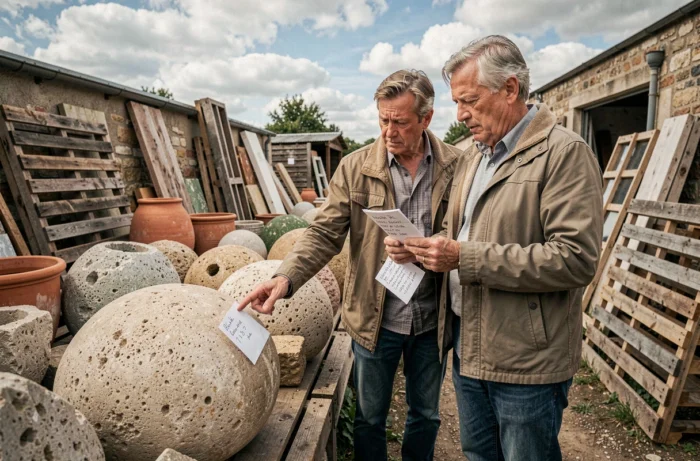
Classified ad sites remain an effective channel, provided you don’t waste hours sorting through useless results. On general platforms, filter by material category and add specific keywords: garden stones, blocks, rock fill, rubble, gravel.
Object donation apps like Geev offer a dedicated category for materials. The advantage: donors expect someone to come pick up, not to negotiate a price. The volume of ads varies greatly by region, but rural and suburban areas offer the best opportunities.
Some tips to increase your chances:
- Activate keyword alerts to be notified as soon as a free stone ad appears near you
- Post your own search ad: many property owners don’t think to offer their stones until someone asks
- Check the type of rock before you go (limestone, granite, schist) to avoid collecting a material unsuitable for your project
Transporting large stones: anticipating weight to avoid unpleasant surprises
Finding free stones is pointless if the transport costs more than buying from a quarry. Weight is the variable that dictates all logistics. A seemingly modest granite block can easily exceed a hundred kilograms.
A standard utility vehicle typically supports a few hundred kilograms in its loading space. Beyond that, you need to consider a reinforced trailer or the occasional rental of a dump truck. Some equipment rental companies also offer forklifts or mini-cranes for daily use.
Before each collection, estimate the volume and weight of the targeted stones. Prepare straps, rolling boards for the heaviest blocks, and at least one additional person. A reinforced hand truck makes handling much safer for medium-sized stones.
The real cost of a free stone is measured in fuel, possible rental, and time spent. Combining several collections on the same trip remains the most economical method to build a stock of garden stones without spending more than a direct purchase.