Choosing fitness equipment for home training involves balancing three rarely aligned variables: the sporting goal, the available space, and the budget. Comparing these parameters before any purchase helps avoid the accumulation of underused devices, a common pattern when the decision is based solely on marketing appeal.
Required space and actual footprint: the first selection filter
The dimensions stated by the manufacturer are not enough. The movement area around the device is as important as the device itself. A compact stationary bike remains unsuitable if the lateral clearance prevents getting on or off without hitting a piece of furniture.
A treadmill requires clear space in front and behind, plus a safety area in case of sudden stops. A rowing machine, once unfolded, often occupies the entirety of a modest-sized room. The stationary bike remains the device that takes up the least floor space.
In an apartment, the issue of vibrations transmitted to the floor and walls adds to the space consideration. A treadmill or exercises involving jumps generate impacts that the neighbors can perceive even if the noise seems moderate in the room. The type of flooring and the insulation of the home influence the choice as much as the machine’s performance. Several specialized catalogs, such as the Profil Sport website, categorize their devices by usage type, which facilitates this initial sorting.
Comparison of fitness devices according to goals and constraints
The table below crosses the main types of equipment with the most discriminating decision criteria.
| Device | Main Goal | Footprint | Joint Impact | Noise / Vibrations |
|---|---|---|---|---|
| Treadmill | Cardio, calorie expenditure | High (length + clearance) | Moderate to high | High (ground impacts) |
| Stationary bike | Gentle cardio, recovery | Low | Low | Low |
| Spinning bike | Intense cardio, endurance | Moderate | Low | Low to moderate |
| Rowing machine | Full-body strengthening | High (length) | Low | Low |
| Elliptical bike | Impact-free cardio | Moderate to high | Very low | Low |
| Dumbbell set + bench | Targeted strength training | Moderate (modular) | Variable depending on exercise | Low |
The rowing machine stands out as the most versatile device for overall strengthening. The elliptical bike protects the joints better than any other cardio machine. The treadmill generates the highest calorie expenditure but imposes the heaviest constraints in terms of space and noise.
Safety standards and repairability: two criteria often overlooked at purchase
The majority of buying guides compare power, programs, and design. Two parameters consistently take a back seat.
ISO 20957 standard for home use
The ISO 20957 series defines general safety requirements and testing protocols for indoor fitness equipment, with a specific class for home use. Checking compliance with this standard in the product documentation provides information on stability, mechanical protections, and clarity of assembly instructions.
A device sold without mention of this standard is not necessarily dangerous, but it has not undergone the standardized tests that guarantee a minimal level of reliability.
Repairability and availability of parts
A broken resistance cable, a faulty screen, or a worn rail can render the device unusable. Assessing repairability before purchase involves three concrete checks:
- The availability of the spare parts catalog on the manufacturer’s website, not just at third-party retailers
- The existence of a network of authorized technicians or, failing that, official maintenance tutorials
- The warranty duration on wear components (belt, bearings, cables), often shorter than the general warranty
A device that is cheaper to buy but irreparable costs more over five years than a more expensive model with available parts.
Complementary strength training and functional fitness equipment
Cardio machines only cover part of the spectrum. For a complete home workout, a few targeted accessories expand possibilities without requiring significant additional space.
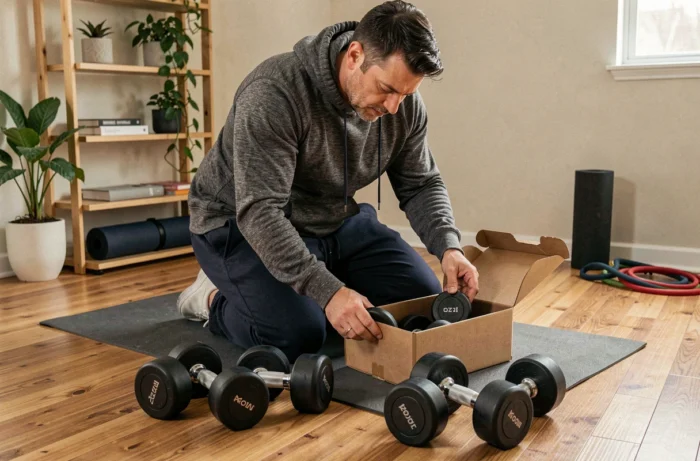
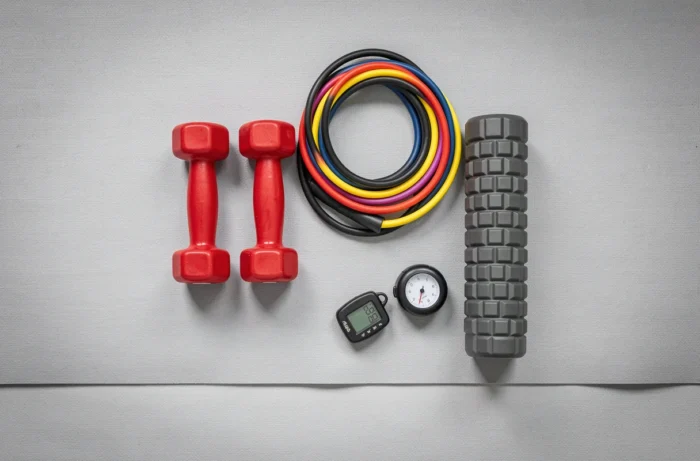
An adjustable bench paired with a set of modular dumbbells allows for working all muscle groups. Resistance bands offer a progressive load suitable for functional exercises (pushing, pulling, rotating, stabilizing). A pull-up bar fixed in a door frame completes the setup for the upper body.
- Modular dumbbells: a single set replaces several fixed pairs and stores in a small space
- Resistance bands: lightweight, compact, suitable for rehabilitation as well as advanced strengthening
- Exercise mat: protects the flooring, cushions floor exercises, and reduces vibrations transmitted to the floor
- Pull-up bar: engages the back, arms, and core without taking up floor space
A limited budget focused on these accessories often yields more comprehensive results than an investment concentrated on a single high-end cardio machine.
Building a progressive home gym without budget mistakes
Buying everything at once often leads to equipment being abandoned after a few weeks. A phased approach works better: start with a cardio device suitable for the space and a minimal strength training kit, then add elements after several months of regular practice.
The first phase aims for two to three sessions per week. If this rhythm holds for two or three months, a second investment is justified. Regular use validates the need better than any theoretical projection.
The final choice depends less on the catalog price than on the combination of actual usage frequency, housing constraints, and the device’s maintenance capacity over time. A home fitness equipment that lasts and serves is one whose purchase was preceded by these three checks, not by a promotion.