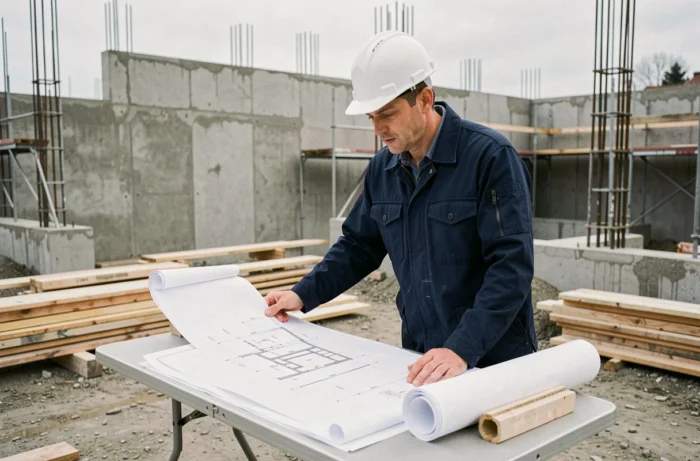
A clay soil in zone B2, a builder announcing a twelve-month timeframe, a PTZ with newly changed conditions: every new house construction project in France starts with its own unique variables. Before discussing budget or plans, it’s worthwhile to identify the real constraints of the land and financing, which dictate everything else.
Soil Study and Land Constraints: The Real Starting Point of a Construction
Since the implementation of the Élan law, a geotechnical study is mandatory for the sale of buildable land located in areas at risk of clay shrinkage-swelling. This refers to a G1 diagnosis, which identifies risks related to the nature of the soil.
This document determines the type of foundations, and thus the overall cost of the project. On clay soil, deep or semi-deep foundations can represent a significant additional cost compared to shallow foundations on stable ground. Ignoring this step is akin to budgeting blindly.
The choice between subdivided land and scattered land has direct consequences. A subdivision generally offers land that is already serviced (water, electricity, sanitation connections). Scattered land may require servicing work, the cost of which varies greatly depending on the distance to the networks.
To compare available offers across the territory, the site faireconstruire.info lists programs and land by location, allowing for a comparison of land prices and technical constraints right from the research phase.

RE 2020 and Individual House Construction: What Changes in 2026
The environmental regulation RE 2020 has applied to individual houses since 2022, but its thresholds are tightening in stages. In 2025, the threshold for the construction IC indicator (carbon impact of materials) decreased, and a new stage is planned to further strengthen the requirements on energy IC.
Material choices directly influence RE 2020 compliance. Wood, low-carbon concrete, or terracotta bricks do not have the same carbon footprint, and therefore do not have the same impact on the calculation of construction IC. A builder who only offers standard concrete blocks without compensation will find it more difficult to meet upcoming thresholds.
On the energy performance side, RE 2020 imposes a minimum use of renewable energies and a summer comfort indicator (number of discomfort degree-hours). In southern regions, this may require solar protections, enhanced thermal inertia, or specific ventilation. The cost of RE 2020 compliance is negotiated from the estimate, not after the contract is signed.
CCMI Contract and Guarantees: Concrete Protections for the Buyer
The individual house construction contract (CCMI) is the most protective legal framework for individuals building a house. It imposes several non-negotiable obligations on the builder:
- A firm and definitive price, adjustable only according to an official index (BT01 index), which protects against budget overruns during construction
- A delivery guarantee at the agreed price and deadlines, backed by a financial guarantor (bank or insurer), who takes over if the builder defaults
- The ten-year guarantee, which covers defects affecting the solidity of the work or rendering it unfit for its purpose for ten years after acceptance
- The one-year perfect completion guarantee and the two-year guarantee for separable equipment such as plumbing or heating systems
Checking the delivery guarantee certificate before signing is the most underestimated precaution. Without this document, the CCMI loses much of its protective value. One can ask the builder to provide this nominative certificate, issued by their guarantor, as early as the negotiation phase.
PTZ 2025-2026 and Financing a New Construction Project
The Zero-Rate Loan has been expanded since April 1, 2025, to include the construction of new individual houses across the entire territory, including in zones B2 and C. This extension changes the game for projects in rural or peri-urban areas, where land is cheaper but where the PTZ was previously restricted.
Income ceilings determine eligibility and the amount that can be financed. The PTZ only covers a fraction of the total project cost, usually supplemented by a main loan, personal contribution, and possibly other local aids. The income rule to be respected depends on the geographical area and the composition of the household.
A point of caution: the PTZ is subject to energy performance conditions for the housing. With the tightening of RE 2020, this requirement is generally met by default for new constructions, but it must be ensured in the compliance certificate.
Building Permits and Local Market: Realities Varying by Region
New housing authorizations experience contrasting regional dynamics. In Brittany, for example, permits for individual houses and construction starts have significantly increased in recent times, while the national trend remains more mixed. Thinking at the scale of the living area rather than the national scale helps avoid misjudging the feasibility of a project.
The processing time for a building permit for an individual house is generally two months from the submission of a complete file. In practice, requests for additional documents or consultations with the architects of the buildings of France (in protected areas) can extend this timeframe. Anticipating this step in the project timeline helps avoid cascading delays in financing and delivery.
The gap between permits granted and actual construction starts remains an indicator to watch: obtaining authorization does not guarantee the start of work, especially when financing conditions or material costs change between the request and the start of construction. This discrepancy explains why the resumption of authorizations does not mechanically translate into an increase in the supply of new housing available.